Hamilton’s Catherine Beck joins a $20 million NSF project to build a new drilling platform
The National Science Foundation awarded $20 million to a team that includes Hamilton geosciences professor Catherine Beck, to design a modular drilling platform for large lakes and nearshore waters.
By Diane Pompo
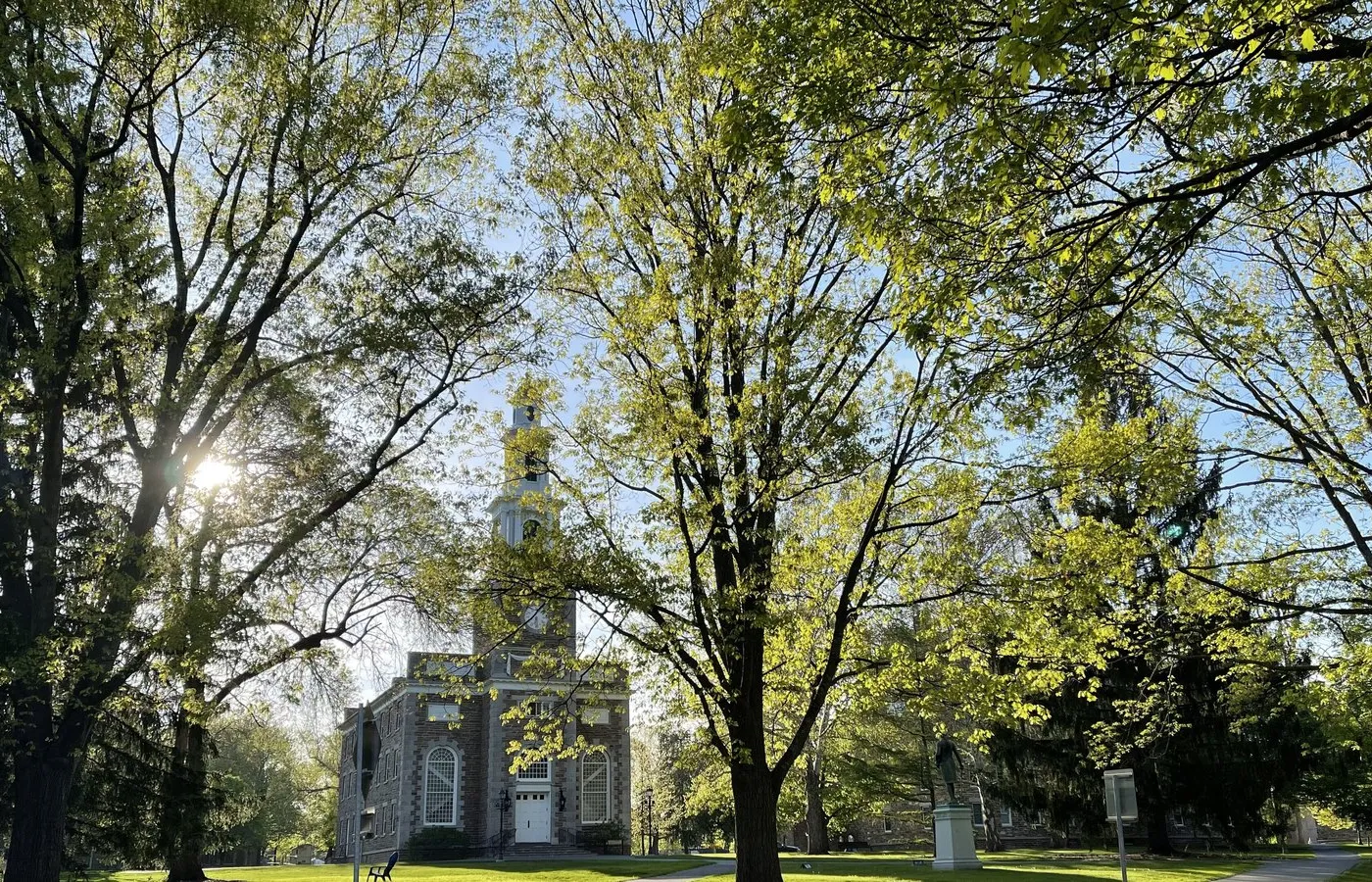

Hamilton College Associate Professor of Geosciences Catherine Beck is part of a research team that has been awarded $20 million by the National Science Foundation to design a modular drilling platform for work on large lakes and in nearshore marine waters, the college announced Nov. 11.
The project, titled Expanding Science Frontiers through Continental Drilling, is led by Anders Noren, director of the University of Minnesota’s Continental Scientific Drilling Facility. Hamilton is listed among the partners, with Brown University, Missouri University of Science and Technology, the University of Notre Dame, Arizona State University, Syracuse University and the University of Wyoming.
The new system is meant to collect sediment and rock cores at sites that existing platforms cannot reach. Drill cores are cylinders of sediment and rock whose layers, the college said, preserve evidence researchers cannot collect in other ways. Because several scientific questions can be asked of the same site, one expedition can serve more than one team and spread the cost.
A platform built to be shipped and assembled
Plans call for transportable modules that can be shipped and put together for each expedition. The college said the Continental Scientific Drilling Facility is asking researchers who use drill cores — in hydrology, climate, ecosystems, geology, biology and human history — to help shape the design through workshops and other comments. A traineeship will bring in a cohort of early-career researchers and marine engineers.
A smaller coring platform already offered by the Minnesota facility can be assembled on site in remote places. The new platform, the college said, will be more than 50 times larger.
“Acquiring this infrastructure has been a long-term goal of the scientific drilling community so this is a major step forward,” Beck said in the college’s announcement. “These funds will enable us to dream big with our science and collect records previously inaccessible with the previous technologies.”
She said the grant also has a teaching side that will show up in her Hamilton courses, including 3-D printed models of the barge components that would let students design and “build” their own lake-based coring project.
Noren said scientists have already made the case for the capability in white papers, published articles and proposals. “This platform will give them access to high-priority sites that can answer frontier scientific questions,” he said. “And because a single core sample can serve researchers studying numerous topics across decades, the value of an expedition extends well beyond any one project.”
What it means for Beck’s work in the Turkana Basin
The NSF infrastructure award sits alongside Beck’s Turkana Basin Drilling Project, called TARGET, which is studying links between environmental change and hominin evolution over the past 4 million years. Phase 1 of that project received $1.9 million to drill on land through the International Continental Scientific Drilling Program. Phase 2, the college said, will rely on the new modular platform, and one of the graduate student or postdoctoral trainees this summer will likely be mentored by Beck in planning how the platform would be used on Lake Turkana.
Beck’s lab is one piece of a wider research presence on College Hill. The college has also recently highlighted other federal grants, including work on deer, rodents and forests, and a five-year NSF study of how rural communities think about climate action. Campus news of a different kind was in our report on Hamilton’s first Jazz Workshop, which brought 74 area students to campus, and on the field hockey team’s run into the NCAA tournament.
In the village, the other large infrastructure question this month is closer to home: a $28.5 million wastewater plant project the village is weighing with a private partner. More campus coverage is in our College Hill section.