Hamilton College’s 1820 cemetery now has a searchable map built by student archivists
A student-built ArcGIS story map puts biographies to the stones on College Hill, from Samuel Kirkland and Skenandoah to the rebellious class of 1884.
By Hannah Mohr

Hamilton College’s cemetery on College Hill has been taking burials since 1820, eight years after the college was founded. Now its residents have a searchable online map, built by students in the college archives who spent months matching headstones to biographies.
The ArcGIS story map was finished this past summer by Connor Havelka, a member of Hamilton’s Class of 2028 and a Curatorial Studies intern, building on earlier design work by Ella Strasser, a 2026 graduate. The college described the project in a Nov. 9 interview with Havelka, after he and College Archivist Jeremy Katz led an Oct. 30 tour of the grounds.
For anyone who has walked the cemetery, which sits between Bristol Center and Morris House, the map puts names to stones. Notable figures are highlighted, and the map can be searched and filtered.
Who is buried on the hill
The cemetery holds former presidents, professors, librarians and the namesakes of many campus buildings. Among the best known graves:
Samuel Kirkland and Skenandoah. Kirkland, the missionary who founded the Hamilton-Oneida Academy that became the college, died in 1808. Skenandoah, the Oneida leader and his longtime friend (we told his story here), asked to be buried beside him and was, on the grounds of Kirkland’s Clinton home, after his death in 1816. According to the college’s own history of the cemetery, both were moved to their adjoining plots on College Hill in 1856.
Elihu Root. The Clinton native, a Hamilton graduate who served as secretary of war and secretary of state and won the 1912 Nobel Peace Prize, is buried there with his wife, Clara.
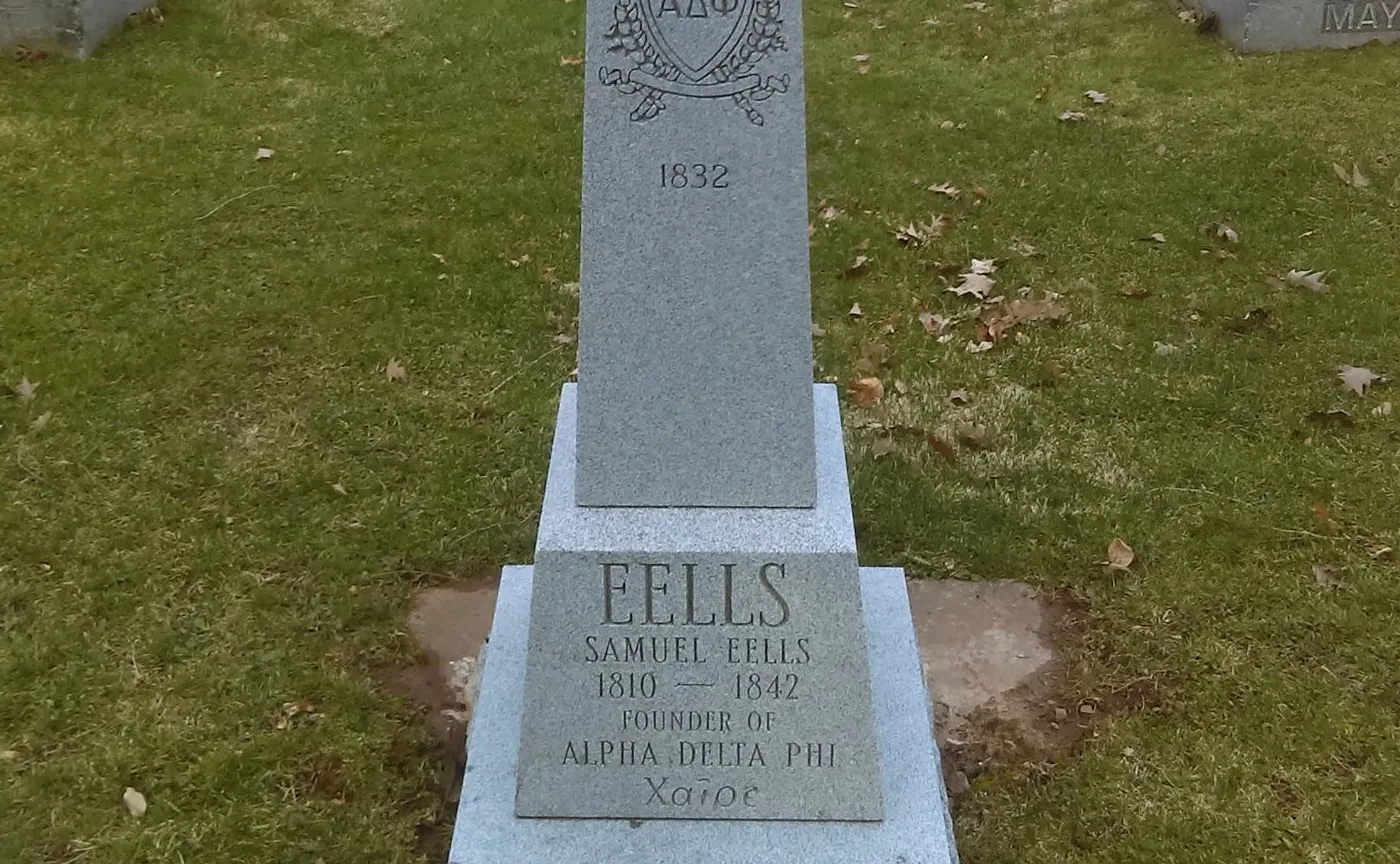
Samuel Eells. The founder of the Alpha Delta Phi fraternity, which started at Hamilton in 1832, has a granite obelisk put up after his reburial in the cemetery in 1999. His remains had a long trip there: buried in Cincinnati in 1842, moved to Cleveland in 1859, then brought back to Clinton around 1930 and kept for decades beneath the floor of the fraternity’s lodge room, according to the college archives. Havelka cited the bones under the floorboards as one example of a college history that is “not all stuffy classrooms.”
The 1884 class stone
Havelka said the story that stayed with him most was the 1884 class stone. In February 1884, after former college president North died, the senior class skipped Monday classes it expected to be canceled before the funeral. President Darling suspended several class leaders, and the seniors left campus as a group. They returned only after the dispute threatened the job of the popular professor known as “Old Greek” North. Their class stone carries a reminder of the walkout: a bolt resting on a tree trunk.
The research mostly drew on nearly 200 years of the college’s alumni magazine, with its memorials and necrologies. Havelka said family members who had no direct tie to the college were much harder to trace, and he often turned to newspaper archives and genealogy sites.
Gaps in the record
The project also turned up what Havelka called “little injustices”: three people buried without headstones, several with no birth or death year, crumbling stones, a former president’s grave “stuck in the mud,” and wives and daughters missing from the written record. He said he hopes the map draws more visitors, and that some of those gaps get fixed.
He also pointed out that the cemetery was laid out to be used by the living, “a park to picnic in just as much as a final resting place.”
The map is available through the Hamilton College Archives. For more on the people and places of College Hill, see our Features section, including our profile of historian Maurice Isserman, and more campus news on the College Hill page.